Citizenship Certificate in Nepal (2026): New, Duplicate, Correction, NRN & Legal Process
Citizenship Certificate in Nepal (2026): New, Duplicate, Correction, NRN & Legal Process: professional legal guide from Nepal Legal Firm covering Citizenship Nepal, Nagarikta, DAO Process.
Complete legal guide to Nepali citizenship in 2026: who qualifies, required documents, DAO process, duplicate/correction procedure, appeals, and latest amendment checkpoints.
Why This Is the Missing Core Topic
Your legal rights in Nepal usually begin with one document: the citizenship certificate (नागरिकता प्रमाणपत्र). Without it, practical access to passports, banking, property transfer, higher education paperwork, and many state services becomes difficult.
Most online guides only cover one narrow issue (for example, mother’s name cases only, or only duplicate copies). This guide is intentionally built as a single end-to-end legal map.
As of March 5, 2026, this article is based on constitutional provisions, the Citizenship Act text, and DAO/MOHA official service notices.
Legal Basis You Must Know First
1. Constitution of Nepal (Part 2: Citizenship)
The Constitution sets the top-level framework:
- Article 10: No citizen shall be deprived of the right to obtain citizenship.
- Article 11: Core citizenship routes (descent, specific naturalization situations, found child, etc.).
- Article 12: A person eligible by descent can obtain citizenship certificate by the name of mother or father (gender identity basis).
- Article 14: Non-Resident Nepali citizenship framework (economic, social, cultural rights under federal law).
2. Nepal Citizenship Act, 2063 (2006)
Key operational sections:
- Section 3: Citizenship by descent.
- Section 5: Naturalized citizenship categories.
- Section 8: Application process and required supporting documents.
- Section 10 & 11: Termination and re-acquisition rules.
- Section 13: No dual certificates; replacement with withdrawal of prior certificate.
- Section 14 & 18: Appeal/revision rights.
- Section 17: Correction and amendment of particulars.
- Section 21: Penalties for false representation and forged use.
Which Citizenship Route Applies to You
A) Citizenship by Descent (वंशज)
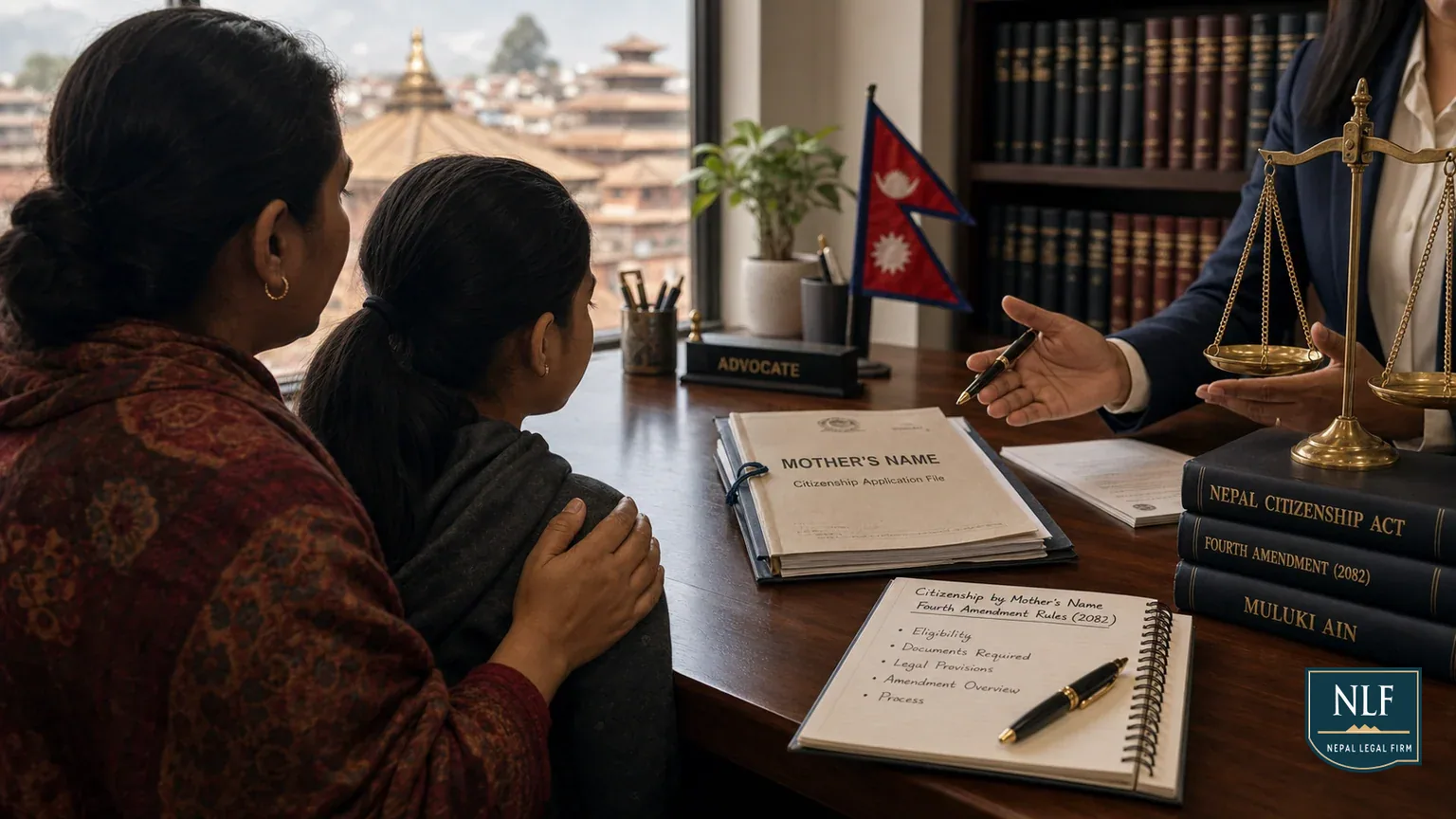
Constitutionally, this is the most common route. In general, if father or mother was a Nepali citizen at your birth, descent route is the starting point.
Article 11 also includes a key transition category: a person born in Nepal to a parent who had citizenship by birth can obtain citizenship by descent at majority where both parents are Nepali citizens.
The Citizenship Act process references filing after reaching required age (16 in the Act’s framework) with prescribed documents.
B) Naturalized Citizenship (अंगीकृत)
The Act includes multiple categories, including:
- Foreign woman married to a Nepali citizen (application in prescribed form).
- Person born in Nepal to a Nepali mother where the father is not traced (constitutional and statutory route with documentary verification).
- Person born in Nepal to a Nepali mother and foreign father may qualify for naturalized citizenship where constitutional conditions (including permanent domicile and no foreign citizenship claim) are met.
- Other exceptional naturalization by Government of Nepal under statutory conditions.
C) Non-Resident Nepali Citizenship (NRN)
Constitution Article 14 allows non-resident Nepali citizenship to eligible foreign citizens of Nepali origin (outside SAARC countries), with rights defined by federal law. It is not identical to full political citizenship rights.
Documents Checklist (Practical DAO Layer)
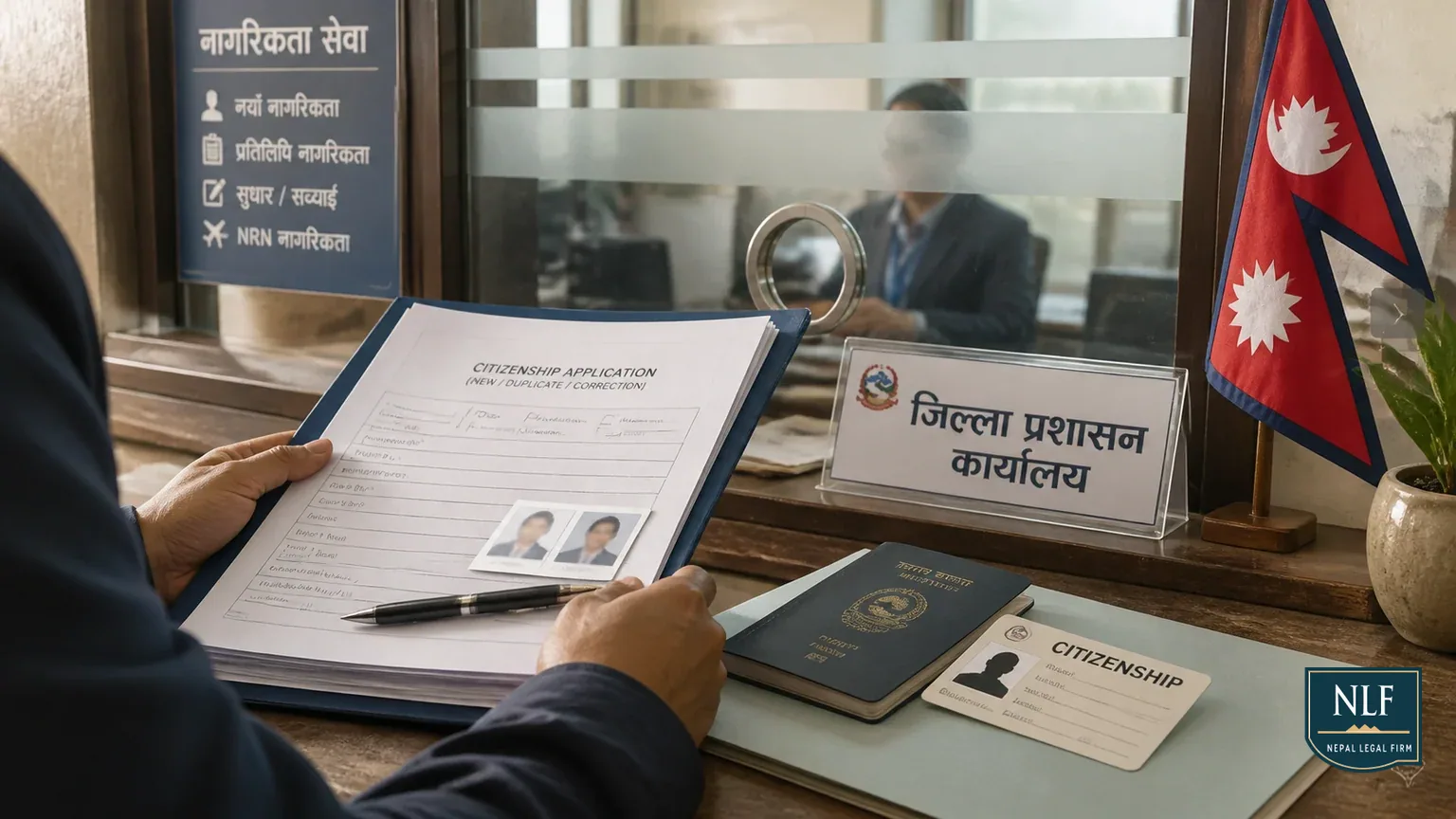
Actual document handling happens at DAO/local body level. District-level citizen charters show a similar pattern, with minor local variation.
1. For New Citizenship by Descent
Commonly listed requirements include:
- Prescribed Schedule-1 form certified/recommended by local authority.
- Parent’s citizenship certificate, or in some cases close blood relative citizenship within three generations.
- Relationship proof (where required by office practice).
- Photos and local recommendation documents.
District citizen charter pages also show that if documents are complete, processing is often done the same day in many offices.
2. For Married Woman (Record/Particular Update Route)
District guidance commonly asks for:
- Schedule form with local recommendation.
- Marriage registration certificate.
- Husband/father-in-law citizenship copy (as applicable in local checklist).
- Natal family-side identity references where required.
3. For Naturalized Application Buckets
For the Section 5(3)-type category (person born in Nepal to a Nepali mother where father is not traced), the Act text specifically points to documents such as:
- Mother’s citizenship copy,
- Local recommendation confirming birth/permanent residence,
- Evidence that foreign citizenship has not been acquired in the relevant legal context.
For Constitution Article 11(7)-type cases (Nepali mother + foreign father), DAO checklists and supporting declarations become critical and should be verified against the latest district circular before filing.
4. For Duplicate/Copy (प्रतिलिपि)
District DAO service pages commonly require:
- Application with local recommendation,
- Old torn copy / prior certificate number and issue date (if available),
- Supporting identification from family records when old record is unclear.
Some DAO charters explicitly mention a postal ticket fee model (often around NPR 10 for new issue, NPR 13 for duplicate copy in listed examples), but this can vary by office circular.
Step-by-Step: How to Actually Apply
- Confirm your category first: descent, naturalized, duplicate, correction, or re-acquisition.
- Get local-body certified form and recommendation in the prescribed format.
- Build document bundle exactly as your DAO currently requires (do not rely on old social-media checklists).
- File at the designated DAO citizenship section.
- Attend verification/spot inquiry if called.
- Receive certificate/decision; if denied, take written reasons and move to legal remedy timelines.
What If You Do Not Have Full Documents?
Citizenship Act Section 8 contains an important safeguard:
- If complete documentary evidence is not available, the designated authority may proceed through spot investigation.
- Identification can involve persons from the same ward who already hold citizenship and know the applicant.
This is not automatic approval, but it is an important legal path where records are old, damaged, or incomplete.
Recent Amendment Checkpoint (Do Not Skip)
Official MOHA/DAO notices and legal document postings show continuing updates after the original 2063 Act framework, including:
- Nepal Citizenship (First Amendment) Act, 2079 (published in Gazette date shown in official DAO/MOHA notices: 2080/02/17).
- Nepal Citizenship (Second Amendment) Act, 2082 (published document posts in official administration portals).
- Citizenship Regulation amendments, including third and fourth amendment postings.
Practical takeaway: Always verify the latest prescribed forms and checklist at your district DAO before filing, especially for mother-name, birth-basis lineage cases, naturalization, and record updates.
Appeals, Revision, and Legal Remedies
If citizenship is refused, canceled, or altered unfairly:
- Section 14(2): Appeal window is provided (35 days in Act text for the covered cancellation context).
- Section 18: Aggrieved person may seek revision within 35 days under the mechanism in the Act.
Do not wait informally after rejection. Get the written decision and move within statutory time limits.
Loss and Re-Acquisition: Critical Rule
Citizenship Act Section 10 provides automatic loss framework if foreign citizenship is voluntarily acquired.
Section 11 allows re-acquisition when legal conditions are met (including renunciation evidence and formal process before designated authority).
This area is where many high-profile disputes in Nepal have occurred; documentation sequence matters.
Criminal Risk: False Documents Are Not a Minor Error
Under Section 21, penalties can include imprisonment and fines for:
- False representation to obtain citizenship,
- Forged citizenship use,
- Assisting fraudulent issuance,
- Unauthorized alteration of certificate particulars.
If your records contain inconsistencies, fix them through Section 17 correction process; do not use shortcuts.
Fast FAQ
Can I apply in any district?
In practice, filing is tied to designated authority and locality rules; confirm jurisdiction with your DAO before submission.
Is there one fixed nationwide fee?
No single fee line applies to every service type in every district notice. DAO charters often use postal-ticket-based fees and service-type variation.
How long does it take?
Many district charters say “same day” when documents are complete, but verification-heavy cases can take longer.
Can I correct name/age mistakes later?
Yes. Section 17 allows correction/amendment through application and evidence, with withdrawal/reissue mechanics.
Is NRN citizenship the same as full Nepali citizenship?
No. NRN citizenship is a constitutionally distinct category under Article 14 with limited scope defined by law.
Primary Sources (Official)
- Constitution of Nepal (English PDF, Nepal Law Commission): https://giwmscdnone.gov.np/media/files/Constitution%20of%20Nepal%20%282nd%20amd.%20English%29_xf33zb3.pdf
- Nepal Citizenship Act, 2063 (English PDF, Nepal Law Commission): https://giwmscdnone.gov.np/media/app/public/275/posts/1721032585_65.pdf
- DAO Kathmandu notice referencing implementation after First Amendment publication (2080/02/17): https://daokathmandu.moha.gov.np/en/post/citizenship-14
- MOHA post: Nepal Citizenship (First Amendment) Act, 2079: https://www.moha.gov.np/post/na-pa-l-na-gara-kata-paha-l-sa-sha-thhana-aina
- DAO/administration publication examples for updated amendment documents (Second Amendment Act, 2082 and Fourth Amendment Rules, 2082): https://aaokatari.moha.gov.np/post/nepal-citizenship-act-2063-second-amendment-2082-b-s https://daochitwan.moha.gov.np/post/na-pa-l-na-gara-kata-tha-sa-ra-sa-sha-thhana-aina-2 https://daochitwan.moha.gov.np/post/na-pa-l-na-gara-kata-ca-tha-sa-sha-thhana-na-yama-val-2
- District citizen charter/service examples (documents, fee/time patterns): https://daoparsa.moha.gov.np/en/services https://daomanang.moha.gov.np/en/services https://daobaitadi.moha.gov.np/en/page/copy-of-citizenship-certificate https://daodarchula.moha.gov.np/en/post/required-documents-to-make-citizenship-1
Disclaimer: This is legal information, not a substitute for case-specific legal advice. DAO practice can differ by district and by latest circular; verify current checklist before filing.
Important Note
This article provides general information and should not be considered as specific legal advice. Always consult with a qualified attorney for your particular situation.
Utsav Prakash Sigdel
Senior Legal Advisor with expertise in corporate law and legal consultation.